One of the most fascinating, and resonating things I learned about during the course of gaining my Sociology degree, was about the concept of privilege.
Privilege is (dictionary definition):
A special right, advantage, or immunity granted or available only to one person or group of people.
When applied to structures in society, it means that some groups are given advantages on the basis of various arbitrary (i.e. unrelated to merit) conditions. The most common types of privilege that are discussed are white privilege and male privilege. But privilege exists in many different forms. And one of the key things about privilege is that people who have it fail to see what unearned advantages they have in society, believing that they have gotten where they are purely by hard work. The barriers to others are invisible, and the victims are blamed instead of the structures being challenged.
I will rant and rave and complain and moan about privilege from time to time, but I think that it's important that I recognise the ways in which I am privileged, as well as the ways in which I am disadvantaged.
I do not see these things as inherently good. When I say that I am privileged to be white, I don't mean that I think it is better to be white than to be black (or any other colour or ethnicity). Far from it - I am a passionate believer in equality. All that I am saying is that I realise that being white gives me certain advantages, since the society I live in is racist in various overt and covert ways.
I am privileged because I am white. My skin colour doesn't automatically make people think I am a thief when I walk into a shop, an illegal immigrant when I sit on a bus, a prostitute when I get into a car (all things I have heard of happening anecdotally). I can open a newspaper or a magazine and be confident that I will see people of my ethnicity depicted in positive as well as negative ways. These are just a few of the ways in which being white gives me a position of privilege in modern Irish society. I am also privileged not to be a Traveller, in which case I would be thought of as stupid and dirty and a drain on society.
I am privileged because I am straight. If I fall in love I can marry the person I love, as it would be (and in fact was) a heterosexual marriage: I can celebrate my love for a partner without being called dirty or sinful or disgusting or a multitude of worse words. I can walk down the street holding hands with or kissing a partner without it making me fearful for my safety. I can turn on the television or read a book and see people in relationships like mine depicted as normal. I don't get regularly confronted with polls on other people's opinions, who are completely unaffected by my decisions and life choices, as to whether I should have equal rights.
I am privileged because I am cisgendered. The way I feel about my body is depicted in society and media as the norm. I don't have to go seeking obscure blogs and websites in order to find others who feel the way I do about the body I was born with. I don't have to deal with people telling me I am a freak or a weirdo, or telling me how I should feel about my body and what I should or should not be allowed to do with it. I don't have the very essence of who I am criticised or lampooned on a regular basis.
I am privileged because I am able-bodied. I can enter shops without a second thought, I can watch a film without having any difficulty, I don't have people look down on me and think I am in some way less than human or less than them because my body or brain is different.
I am privileged because I live in a country that has a safety net. I am not currently working, I have a 2 year old and a baby on the way and the maintenance my ex gives me isn't enough to cover basic living expenses - nowhere near in fact. However, I get an allowance from the state which does cover those basic expenses like food, heat and clothing. If I manage my money well, I may even be able to put some aside from time to time. I did so in the past and this meant that when I had to suddenly and abruptly leave my husband, I was able to do so. I could pay a deposit to rent a new house within days of leaving.
Following on from the previous point, I am privileged to live in a country that allows me as a woman certain rights, such as holding a separate bank account from that of my husband - it allowed me to squirrel some money away, though I didn't expect to need to use it to leave him I was very, very glad to have it when that was the way things turned.I am privileged to live in a Western World country, where finding a new place to live even for a woman in desperate circumstances is as simple as loading a smartphone app and making a few phone calls. Where I am not, as a newly single mother, looked upon with suspicion and revulsion (in general).
I am privileged to live in a country that has freedom of speech. I can complain about the ways in which privilege affects me negatively (oh, and I will!) without fear of being locked up. I am free to own a computer and access the internet and use it to seek and share information. I am privileged to be able and allowed to read and write; ditto for driving.
I am privileged to live in a democracy. I have the right to vote, or the right to abstain from voting. I will not be jailed or killed for going against the majority.
That's all I can think of for now! Of course there are probably other ways in which I am privileged - feel free to use the comments to share them with me if you think of any, or to talk about ways in which you too are privileged. We are all quick to see how disadvantaged we are, but it is good for each of us to check our own privileged from time to time as well, especially if we like to argue that others should do so.
Showing posts with label society. Show all posts
Showing posts with label society. Show all posts
Saturday, 16 March 2013

Sunday, 24 February 2013
Happiness?
I found it very interesting to read recently that a study by San Francisco State University has found that spending money on life experiences makes us happier than buying stuff (can't find a link to the study itself, just this report on it).
Fascinating stuff. Common sense, in some ways. I mean, in twenty years, are we going to think back on that brilliant holiday, or how awesome that TV, that was at the time top notch, was?
Sure, some stuff is great. I do love my TV shows, but I don't need a massive LED screen that takes up half my sitting room to watch them on. I love my books, but there are only a handful (ok, several armfuls) that I would genuinely feel sad if I no longer hand, and they're mostly books that have some sentimental value for me.
Holidays, dinner parties, events where we can meet new people and perhaps make new friends - they are truly special. Sights that stick with us for the rest of our lives, be they local or far across the world from home. Education, to me at least, is also a life experience worth spending money on. Learning and the pursuit of knowledge are precious to me.
I miss having a car, but it is only a small part to do with the car itself (I had a sporty Fiat Punto). Mostly, I miss that feeling of being able to get in the car and drive, to be able to go anywhere. Bear in mind that I live in Donegal, which is poorly served by public transport, so a car is more of an essential than an optional item really, though I am coping without. But ultimately the car relates to experiences. It brings me to see friends and family. It brings me to the beach, the forests, the parks. It brings my daughter on playdates and to the zoo and all the exciting places that she loves to experience.
What makes you happy - are there material things you couldn't be without? What are your favourite experiences? If you won the lotto, what would you spend the money on that you think would make you happier, or that you would enjoy? What do you save money for?
Tuesday, 22 January 2013
Justice?
Yesterday a man who pleaded guilty - admitted - to raping his daughter regularly over a ten year period walked out of court, free pending an appeal. He was sentenced to twelve years, but the final nine were suspended, and for the first three he was remanded on continuing bail - basically enabling him to walk out of court.
More details of the specifics of the case at these links:
Independent
Irish Times
His daughter waived her right to anonymity in this case so that he could be named and shamed - he is Patrick O'Brien, age 72. He suffers from a "serious medical condition" - but so what?
His victim, the man's own daughter, will never be able to forget the horrific crime he committed. However, she had the right to feel that some semblance of justice would be done. He wasn't old when he first committed the crime. He wasn't sick. So what if he is now? If his crime is worthy of a prison sentence then it is worthy of a prison sentence.
This is just the latest in a long string of cases of leniency meted out to perpetrators of rape, sexual assault, sexual abuse and incest by "Justice" Paul Carney. For example, the time he freed the attacker, leading his victim to have to travel home on the same train as him. Or the time he forced a victim to stand in front of the men she accused of gang raping her and point at them, leading her to try to take her own life. Or the time he said that the crime merited a sentence of nine years, but on account of the perpetrator's good employment record and lack of other convictions, he suspended half of it.
Carney has a bad record when it comes to sex crimes, but he isn't the only judge in the country who does - look at the examples from last year of a man sentenced to six years with the final FIVE AND A HALF suspended as well as being ordered to pay compensation to his victim - paying her for sex which she did not consent to, essentially. And the perpetrator who offered compensation to his victims.
We need to look at this as a society - why are sexual offences not considered serious enough to merit mandatory minimum sentencing? What should it matter if a perpetrator is now old and decrepit - he once wielded the power to commit the crime, and that is what should be taken into account. Who cares if he has no other convictions? Once is enough to affect a victim's life forever, and at least once a week as happened in this case was certainly enough to ruin her childhood. Risk of reoffending of course should be taken into consideration - but just because a rapist or abuser is old and decrepit now doesn't mean that he wasn't ever a risk, or that he didn't commit other offences while still able-bodied.
There is a facebook page Justice for Fiona Doyle where efforts to get justice in her case are being concentrated and publicised. There is also a petition you can sign.
Please do something - even just share the stories above on facebook or twitter, or in conversation in daily life. So many women are victims of some form of sexual assault during their lives. We have to change this culture a little at a time - from the top down, and the bottom up. Every action counts.
Saturday, 15 December 2012
I recently wrote about the privileged position of religion in the Irish constitution and law and how people who have no religion are discriminated against.
It seems my timing was impeccable, as a few days ago the International Humanist and Ethical Union published a report on discrimination against the non religious. The discrimination I mentioned last week is referred to, and severalk other European countries including the UK have a similar situation regarding secularity and religion and the protection of law.
However, as much as I love to complain, we don't have it so badly here. Not really.
There are countries where you can be sentenced to death for not subscribing to the state religion; for having a different belief or for being an atheist or agnostic. Those countries are: Afghanistan, Pakistan, Saudi Arabia, Iran, Sudan, the Maldives & Mauritania.
If you have time, go read the report, or bits of it anyway. It's good to be informed, and to understand what a truly toxic relationship the marriage of state and religion can be.
A secular society is not an atheist one. It is not fundamentalism in any sense whatsoever. People in a fully secular society would be fully free to believe whatever they wish, and participate in rituals of whatever religion they choose (as long as their rituals don't infringe on the rights of others!). However, the laws would not favour one religion or type of belief over another. The law would ensure that schools and health services are not tarnished by religious morality. The law would ensure that taxpayers' money would not fund religious activities. The law would create a fair system - a truly democratic one. One in which innocent children are not subjected to declarations about sin, one in which women are not treated as second-class citizens purely because milennia of religious belief has engraved that notion in people's psyches, one in which the state does not murder its citizens for non-conformity to a belief system.
A final point - as shocking as it can be to learn about things like this, another shocking thing is the fact that I haven't seen this reported ANYWHERE in the mainstream media. Atheist Northern Ireland facebook page alerted me to it.
Thursday, 13 December 2012
The logo board game. UGH!!!
I love board games. I really enjoy them, we used to play them a lot when growing up and it is a tradition that has continued to this day.
Among the favourites were:

Scrabble!
Which continues to be a favourite today,
Monopoly,

in which we (and by we, I mostly mean my sister and I) forget completely that we are empathic creatures who subscribe to a somewhat socialist, humanist philosphy, and become Dickensian-style capitalists, ready to turf each other out on the streets if we can't afford a room in one of those hotels.
In my younger days, I used to play with younger bro and sis, and unbeknownst to them, I used to steal from the bank to ensure I won (this was in my teenage years). Looks like I had the measure of capitalism, eh?!
and some others like

Mandarin, which was sort of a cross between Monopoly, Ludo and some sort of bingo;

Yahtzee, which was something to do with numbers and dice? I don't remember it very well...

And Upwords, which was like Scrabble in 3D.
Plus of course, Ludo, though we called it something else I think (the Dutch name maybe?) which escapes me right now.

 The Logo Board Game.
Tag line: "Of things you know and love".
VOMIT!!!
Teaching children brand loyalty.
Shell oil, a company whose actions in Ireland and elsewhere are deplorable, Burger King, destroying the forests for cattle grazing (and yet still making tasteless, almost meatless burgers) at a rate surpassed only by McD's, Pampers nappies, adding up so much waste per baby that it is drowning the world in landfill. Yeah, let's let kids have some fun with that, shall we?
I know I said we got our capitalist thrills playing monopoly, so maybe this sounds like hypocrisy, but in the purest sense of it, that is only a game. This isn't. This is advertising disguised as play. Every time you are exposed to an image like a logo it becomes more recognisable, and you are more likely to choose it then because it seems familiar, and we generally choose the comfort of familiarity.
This is not a game. This is a marketing ploy. And it makes me want to puke all over it.
Among the favourites were:
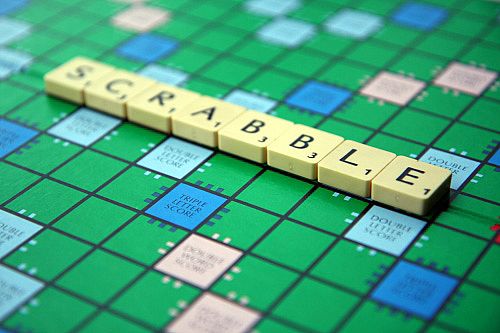
Scrabble!
Which continues to be a favourite today,
Monopoly,

in which we (and by we, I mostly mean my sister and I) forget completely that we are empathic creatures who subscribe to a somewhat socialist, humanist philosphy, and become Dickensian-style capitalists, ready to turf each other out on the streets if we can't afford a room in one of those hotels.
In my younger days, I used to play with younger bro and sis, and unbeknownst to them, I used to steal from the bank to ensure I won (this was in my teenage years). Looks like I had the measure of capitalism, eh?!
and some others like

Mandarin, which was sort of a cross between Monopoly, Ludo and some sort of bingo;

Yahtzee, which was something to do with numbers and dice? I don't remember it very well...
And Upwords, which was like Scrabble in 3D.
Plus of course, Ludo, though we called it something else I think (the Dutch name maybe?) which escapes me right now.

I was browsing a toy catalogue recently, and loving the nostalgia as I saw these and others.
Then I saw it. This horrible, evil thing:

Tag line: "Of things you know and love".
VOMIT!!!
Teaching children brand loyalty.
Shell oil, a company whose actions in Ireland and elsewhere are deplorable, Burger King, destroying the forests for cattle grazing (and yet still making tasteless, almost meatless burgers) at a rate surpassed only by McD's, Pampers nappies, adding up so much waste per baby that it is drowning the world in landfill. Yeah, let's let kids have some fun with that, shall we?
I know I said we got our capitalist thrills playing monopoly, so maybe this sounds like hypocrisy, but in the purest sense of it, that is only a game. This isn't. This is advertising disguised as play. Every time you are exposed to an image like a logo it becomes more recognisable, and you are more likely to choose it then because it seems familiar, and we generally choose the comfort of familiarity.
This is not a game. This is a marketing ploy. And it makes me want to puke all over it.
Wednesday, 12 December 2012
A new word
I learned a new word recently. Not my two year old (she learns new words every day!). I did.
Cis.
As in, I am a cisgendered female. Which means I identify as a female, and am biologically a female. So what, you might think - so did I for half a second when I initially read the word.
Then I realised. It is the opposite of transgendered, to be biologically one but identify as the other.
If there is no word for "the opposite of transgendered" the default word might be "Normal". So you have "trans" people, and "normal" people. That's not so nice territory, as when you switch it around, the opposite of "normal" is "abnormal".
So I am quite happy to say that I am a cisgendered female, and I am delighted that a word exists to describe it, even if I am slightly surprised that I hadn't heard/read it before in all my time studying sociology.
Tuesday, 11 December 2012
Human Rights, and my child's future.
My child is an Irish child, but she does not have the same rights as many other Irish children.
She has citizenship. She is entitled to childrens' allowance.
However, she is not being brought up as a member of any religion. And therefore, she misses out on some other fundamental rights.
For one thing, she can never become President. Article 12.8 of Bunreacht na hEireann (the Irish Constitution) states that upon taking office, the President shall swear the following oath (it also refers to the President under the default pronoun "he" but we'll leave that for another day as the sexism in the constitution deserves its own post):
"In the presence of Almighty God I ,do solemnly and sincerely promise and declare that I will maintain the Constitution of Ireland and uphold its laws, that I will fulfil my duties faithfully and conscientiously in accordance with the Constitution and the law, and that I will dedicate my abilities to the service and welfare of the people of Ireland. May God direct and sustain me."
Atheists do not believe in god, any god. While the lines in the oath have a very Christian slant, a Muslim could nevertheless take office as he or she calls god "allah"; or a Buddhist who calls their god "Buddha" but nevertheless believes in a "god" to whom the above could refer to. An atheist however, could not in good faith take that oath, because it means nothing to them, and no one watching an atheist take such an oath could believe that it meant anything to them for belief in god is a fundamental part of it.
The same is true for a presence on the Council of State (article 31) and perhaps more importantly, the judiciary (article 34.5.1). A judge in Ireland must swear an oath to god. This oath:
"In the presence of Almighty God I, , do solemnly and sincerely promise and declare that I will duly and faithfully and to the best of my knowledge and power execute the office of Chief Justice (or as the case may be) without fear or favour, affection or ill-will towards any man, and that I will uphold the Constitution and the laws. May God direct and sustain me."
"May God direct and sustain me" - in my role as a judge, as I try to uphold the laws of the land. That is an ill-fit with notions of secularity, as well as meaning that once again, my daughter and others like her could never realistically be considered for the role.How does it even fit with the line that precedes it - "without fear or favour, affection or ill-will towards any man" (man, not person, again!) - what if God directs the judge, by way of religious teachings, to have favour toward one person or ill-will toward another - religion has after all, been used to justify slavery, which certainly counts as using the law to favour one person over another.
And now we come to Article 44 - Religion. It even gets its own article!
Here is the text in full of Article 44:
1. The State acknowledges that the homage of public worship is due to Almighty God. It shall hold His Name in reverence, and shall respect and honour religion.
2.
1° Freedom of conscience and the free profession and practice of religion are, subject to public order and morality, guaranteed to every citizen.
2° The State guarantees not to endow any religion.
3° The State shall not impose any disabilities or make any discrimination on the ground of religious profession, belief or status.
4° Legislation providing State aid for schools shall not discriminate between schools under the management of different religious denominations, nor be such as to affect prejudicially the right of any child to attend a school receiving public money without attending religious instruction at that school.
5° Every religious denomination shall have the right to manage its own affairs, own, acquire and administer property, movable and immovable, and maintain institutions for religious or charitable purposes.
6° The property of any religious denomination or any educational institution shall not be diverted save for necessary works of public utility and on payment of compensation.
Let's start at the start. The state acknowledges the homage of public worship is due to almightly god. Yeah, that's the big one. It presumes the existence of, and belief in, god. Specifically, a (male) god who needs and deserves worship.
The articles which follow are also actually offensive to secularists, not so much as the first, but insomuch as they mention religion constantly, but there is no mention of "No religion". Therefore, the state can't discriminate against religions or people from different religions, but they can discriminate against people who don't belong to any religion, meaning atheists and agnostics too. We are not afforded the same rights. This translates into law too - the nine grounds (equality and anti-discrimination legislation) include religion, but not "No religion" or "religion or lack thereof", therefore in legal analysis, those of us who have no religion are not included and may be discriminated against. The article on schools is vague and legislation around it has interpreted that the churches have a right to discriminate and choose members of their religion over non-members if the school is over-subscribed, as the religion has the "right" not to compromise its principles - the same legislation makes it perfectly legal for schools to discriminate when hiring teachers, and since most of the schools are Catholic, you can guess which sorts of discrimination take place.
Yes, I have chosen this for my daughter, as I chose not to have her christened (my other half was raised Catholic and it would have been very easy to have her baptised, his family would have been all for it!). I chose to make her life more difficult, perhaps? I chose to deprive her of rights which could otherwise have been hers? Those things may be true. I choose another perspective. I choose to bring her up in a way which is right. To not abandon my principles for what would be easier. To fight against discrimination instead of hiding away and pretending to be one of the people against whom no discrimination takes place.
I hope that by the time she is of an age where she could be president or a member of the judiciary, if she should so choose, these articles will have been amended. Because to be able to partake in politics and the justice system of your country are fundamental elements of citizenship, and as a non-religious person, she does not have those rights.
Friday, 7 December 2012
The legacy of religion
I am an atheist, and a passionate secularist - that is, I believe in full separation of church and state, that none of our laws or systems of government/judiciary , or any state bodies such as the health care system or education system should have any grounding in religion or its teachings.
I see great horrors that have been, and continue to be, committed in the name of religion. Female genital mutilation, jihad, the crusades, the pogroms against Jews all over Europe, witch burnings. The list could go on and on and on, describing death - murder - and abuses of many kinds.
However, I do see beauty in the legacy of religion as well.
Take these songs:
Silent night
Away in a Manger
Just two examples. Yes, they are religious. Full on, virgin-birth, angels and Jesus as god religious. However, they are also beautiful. The music more so than the lyrics perhaps, but I do find great beauty in the whole package.
Are there beautiful secular songs? Well perhaps any song that speaks of love of a person, or of the world, without a religious undertone (or overtone), or actually anything at all other than religion, is a secular song. So that is most of the music ever composed, including many modern Christmas songs. Nevertheless, can we ever have too much beautiful music? Should we stop playing religious music just because it's religious? I don't think so.
The Christians stole Christmas from the pagans. I am sure that most modern religious festivals have a pagan heritage, as every society in the world was once pagan of some sort. So why can't the secularists "steal" some of it from the Christians, Muslims, Buddhists etc?
And then we have art.
Some of the most beautiful paintings have a religious motif.
E.g. The Last Supper by Leonardo daVinci
 in which we see Jesus and the apostles at the scene which forms the basis for most of Christianity (the bread anf wine as the body and flesh of Jesus).
Botticelli's The Birth of Venus,

which depicts a nude, gorgeous goddess emerging from a seashell.
or of course, the roof of the Sistine Chapel

These are amazing works of art. Should we disregard them because they depict religious scenes? of course not. They were painted by some of the most skilled artists of their time.
Especially with respect to the Christian scenes, the church at the time of the Rennaissance was a very welathy and powerful patron (at least in part due to the corruption that led to the Reformation, but that's a story for another day!). This was a time before government grants to artists, before such a thing as the Office of Public Works existed, before social welfare for people who weren't working. Earn money to feed yourself, or starve, were the options of the day. So if a wealthy patron offered you the chance to express yourself and your hard-practised talents (Michaelangelo was a grave-robber by night, using cadavers to learn about the human body in order to paint and scult it more accurately), with the caveat that the paintings must contain religious imagry, most would take up the offer, especially at that time.
Religions have been creating things of great beauty for much longer than that though, of course. There is Newgrange, in Co. Meath, Ireland - built approximately 5000 years ago, at the same time as the pyramids. There are the great pyramids of Egypt themselves. There are petroglyphs carved by Native American tribes. There is the cave art of early European societies, most famously Lascaux. These are all expressions of creativity. They refer to sacred spaces, things and thoughts. They are symbols created or built in the name of understanding the world around us. These were all created at a time when religion and science were not at odds. In Newgrange, on the Winter Solstice, the shortest day of the year, the light comes in through to the deepest chamber. That's astronomy as well as religion.The cave art may be an attempt to understand the "spirit world", the supernatural, but it is also the earliest form of the idea of symbolism created by humans, the ability to use a mark to symbolise a real thing, which lead to all other forms of art and writing and is one of the beautiful, abstract things which marks us out as different to other animals (due to our brain evolving differently).
Religion may have started off as a way to understand the world around us. It went hand in hand with science. It was about discovery and exploration, not dogma. It was about trying new things - to appease the gods, people did a rain dance, or made a sacrifice. When something appeared to work they did it again, when it didn't, they stopped. All right, it was chance and not a metaphysical being that caused the apparent effect or lack thereof, but still, that is in principle closer to modern science than it is religion.
At some point, religion decided it had all the answers. No more exploration was needed, no more attempts to discover.
So while objects of great beauty continued to be created, the aim of religion changed. Instead of seeking to discover, it sought to explain and dictate. To control. The opposite of the essence of where it started.
Nevertheless, the desire to explain things that we can't yet understand is a facet of humanity, and religion was once a way to do so. Now, science is a better way. We can enjoy the art, and the music, and continue to explore the universe and always ask why.
I see great horrors that have been, and continue to be, committed in the name of religion. Female genital mutilation, jihad, the crusades, the pogroms against Jews all over Europe, witch burnings. The list could go on and on and on, describing death - murder - and abuses of many kinds.
However, I do see beauty in the legacy of religion as well.
Take these songs:
Silent night
Away in a Manger
Just two examples. Yes, they are religious. Full on, virgin-birth, angels and Jesus as god religious. However, they are also beautiful. The music more so than the lyrics perhaps, but I do find great beauty in the whole package.
Are there beautiful secular songs? Well perhaps any song that speaks of love of a person, or of the world, without a religious undertone (or overtone), or actually anything at all other than religion, is a secular song. So that is most of the music ever composed, including many modern Christmas songs. Nevertheless, can we ever have too much beautiful music? Should we stop playing religious music just because it's religious? I don't think so.
The Christians stole Christmas from the pagans. I am sure that most modern religious festivals have a pagan heritage, as every society in the world was once pagan of some sort. So why can't the secularists "steal" some of it from the Christians, Muslims, Buddhists etc?
And then we have art.
Some of the most beautiful paintings have a religious motif.
E.g. The Last Supper by Leonardo daVinci

Botticelli's The Birth of Venus,
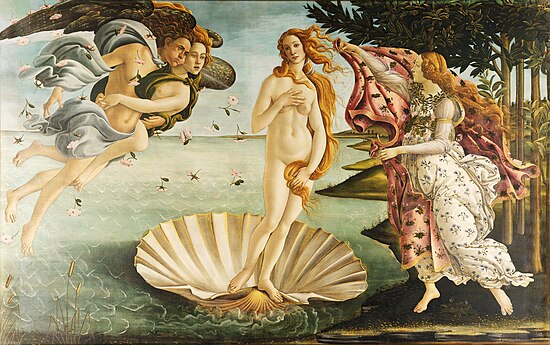
which depicts a nude, gorgeous goddess emerging from a seashell.
or of course, the roof of the Sistine Chapel
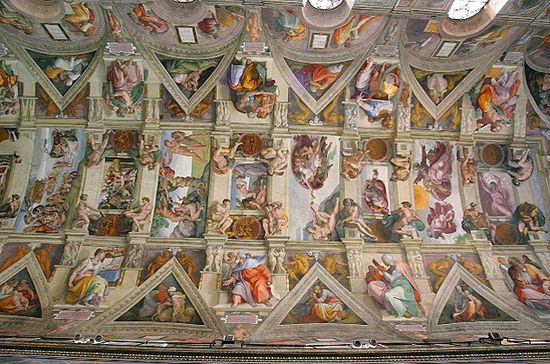
These are amazing works of art. Should we disregard them because they depict religious scenes? of course not. They were painted by some of the most skilled artists of their time.
Especially with respect to the Christian scenes, the church at the time of the Rennaissance was a very welathy and powerful patron (at least in part due to the corruption that led to the Reformation, but that's a story for another day!). This was a time before government grants to artists, before such a thing as the Office of Public Works existed, before social welfare for people who weren't working. Earn money to feed yourself, or starve, were the options of the day. So if a wealthy patron offered you the chance to express yourself and your hard-practised talents (Michaelangelo was a grave-robber by night, using cadavers to learn about the human body in order to paint and scult it more accurately), with the caveat that the paintings must contain religious imagry, most would take up the offer, especially at that time.
Religions have been creating things of great beauty for much longer than that though, of course. There is Newgrange, in Co. Meath, Ireland - built approximately 5000 years ago, at the same time as the pyramids. There are the great pyramids of Egypt themselves. There are petroglyphs carved by Native American tribes. There is the cave art of early European societies, most famously Lascaux. These are all expressions of creativity. They refer to sacred spaces, things and thoughts. They are symbols created or built in the name of understanding the world around us. These were all created at a time when religion and science were not at odds. In Newgrange, on the Winter Solstice, the shortest day of the year, the light comes in through to the deepest chamber. That's astronomy as well as religion.The cave art may be an attempt to understand the "spirit world", the supernatural, but it is also the earliest form of the idea of symbolism created by humans, the ability to use a mark to symbolise a real thing, which lead to all other forms of art and writing and is one of the beautiful, abstract things which marks us out as different to other animals (due to our brain evolving differently).
Religion may have started off as a way to understand the world around us. It went hand in hand with science. It was about discovery and exploration, not dogma. It was about trying new things - to appease the gods, people did a rain dance, or made a sacrifice. When something appeared to work they did it again, when it didn't, they stopped. All right, it was chance and not a metaphysical being that caused the apparent effect or lack thereof, but still, that is in principle closer to modern science than it is religion.
At some point, religion decided it had all the answers. No more exploration was needed, no more attempts to discover.
So while objects of great beauty continued to be created, the aim of religion changed. Instead of seeking to discover, it sought to explain and dictate. To control. The opposite of the essence of where it started.
Nevertheless, the desire to explain things that we can't yet understand is a facet of humanity, and religion was once a way to do so. Now, science is a better way. We can enjoy the art, and the music, and continue to explore the universe and always ask why.
Sunday, 25 November 2012
Breastfeeding Nazis, the Breastapo and Godwin's Law
There are some terms which are used to describe women who are passionate about breastfeeding. They are used in various places including online forums, as well as in the mainstream media, newspapers and other sites which I am not going to link to, but google the terms "Breastfeeding Nazi" and "Breastapo" (from Gestapo) and you'll see a whole range of familar sites come up.
These terms are extremely offensive, and I am going to explain why.
The Nazis were a political party in Germany, full name National Socialist German Workers Party. They are famous because among their policies were the eradication of impure races and peoples, including most notably Jews, but also including Roma/Gypsy people, black people and homosexuals as well as people suffering from various degrees of mental or physical disabilities.
The Gestapo were the Secret Police of Nazi Germany, and were responsible for carrying out many of the atrocities perpetrated by that state against its own and other peoples.
Breastfeeding mums do not wish to put formula feeding mums in gas chambers and kill them. This is what the Nazis and Gestapo did. They killed people who were different to them, who acted differently, who thought differently, had different ideas about what society should be like. I repeat, they killed them.
People who do not breastfeed may find that those who do are smug and self-righteous - personally I disagree or think that at most, this is a very small minority of breastfeeding mothers - but absolutely no one can claim that they aim to eradicate mums who artificially feed their children.
The terms are therefore extremely offensive. Not just to breastfeeding mothers, who do not deserve their comparison with such horrible figures from history. No, the worst offence is to all those people who died or suffered terribly under the Nazi regime. Those who died in the gas chambers, those who died in the camps of disease and starvation, those who died on the roads, those who fell ill and suffered, those who were forever traumatised by the fact that they survived and others didn't, and that they had seen such horrors.
To call someone who you simply disagree with, or who disagrees with you, a Nazi or compare them to the Gestapo, is disgraceful behaviour. Open a history book or turn on the Discovery channel and watch a documentary. Learn what these terms really mean before you throw them out there. It is scary that this is addressed to professional journalists as well as everyday women.
There is an internet phenomenon known as Godwin's Law - that in any argument, eventually someone will compare the other side to the Nazis, and because this is such a worthless argument, the person who does so is automatically judged to have lost the argument.
Please think about the people who died before throwing a term such as Nazi into a conversation, argument or debate. It is not one to be used lightly without denigrating the victims of that awful ideology.
Monday, 19 November 2012
Ulster Says No (Well, Donegal did anyway!)
Here in Ireland we recently had a referendum on the rights of the child . This is because the Irish constitution, written in the good old days of a Catholic Ireland for a Catholic people (Cheers for that, Dev, you old bastard) holds the family unit as the basic unit of society and seeks to protect it at all costs - including those where the rights of the child may be infringed upon.
The referendum was held over a proposed change to this. The former and new wordings are detailed on the official site above. I'm not going to further analyse them, as the vote has already taken place, except to say that I thought the wording of the amendment was somewhat lazy and could have been more detailed, as the way it currently stands it gives a lot of scope to the legislation which will be broughbt in to follow it. However, it was an improvment on the former wording.
The country said yes, though by a much smaller margin than expected - 58% yes to 42% no (rte.ie).
The two Donegal constituencies said no overall - as they have done to several recent referenda. People complain of reasons such as Donegal folk being rebels, the influence of Sinn Fein, and the county still being right wing/religious.
These may be valid points; another valid point may be the argument that Donegal people feel they have to do such things to get attention as it is generally forgotten. It is a county with a high unemployment rate and extremely poor infrastructure.
However, Donegal people love their children every bit as much as people elsewhere in the country. No one ever wants to see a repeat of the Roscommon incest case where there was horrific abuse of children and a court order prevented the HSE taking the children into care.
Donegal folk do however, have a good sense of the difference between the State as ideal, and the actual Modus Operandi of the state.
The official discourse around the subject paints the picture of the ideal state. Who wouldn't want children removed from homes where they are being abused, and adopted into loving, caring homes where they will get the best chances in life? Donegal people know this is just a facade, however.
The official discourse around the Gardai, the Irish police force, would describe them as upholding the law and protecting citizens, but what has happened in the county over the past few decades (e.g. the Frank Shortt case, the McBrearty case, and other incidents dealt with by the Morris tribunal) mean the ordinary people know that things are not that simple.
Similarly, the state as ideal might want to look after children and protect them, but this is the same state that in real life has decimated help for children with special educational needs , has cut funding for youth projects especially in the disadvantaged areas that need them most and has threatened to cut childrens allowance (though personally I feel this is a ploy, something thrown out there so whatever cuts they do make in the budget they can say, well at least we didn't do this...).
This is the state which doesn't allocate enough resources to social workers as it is, so whatever laws they bring in around helping children who are in situations of domestic abuse, it doesn't look like they'll be able to do much to implement them. The state which, regardless of which party is in power, has been cutting social welfare and increasing taxes, dragging many children closer to the poverty line.
Donegal said no, not because of a lack of compassion over the plight of children in terrible situations, but partly because we know all too well up here that what they say and what they do are two entirely different things.
Subscribe to:
Posts (Atom)